
An inside look at couples counseling, what happens in the room, and what you might discover about your relationship along the way.
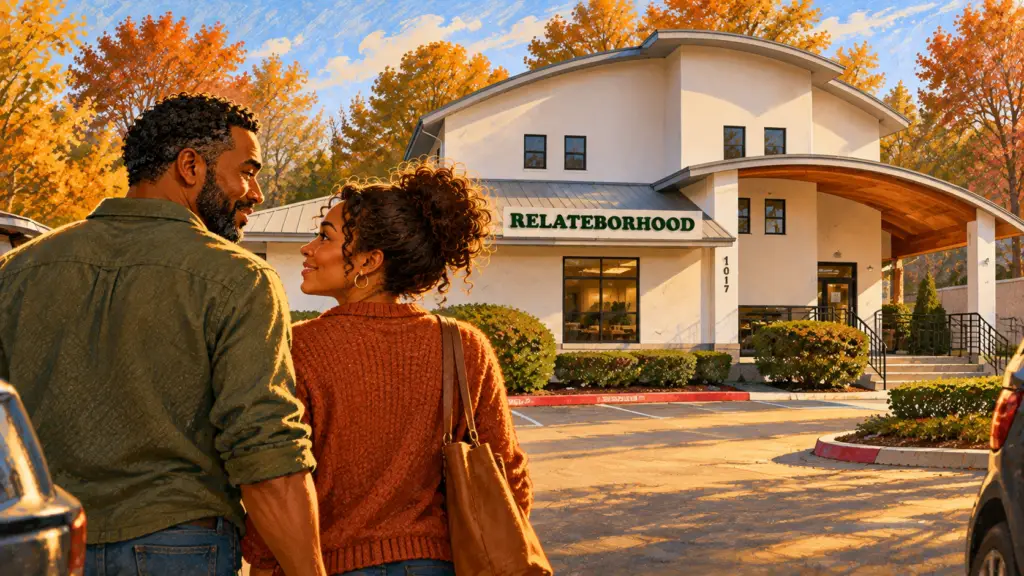
Imagine you’ve just pulled into the parking lot of a counseling office.
It’s 4:57 p.m.
Your appointment is at 5:00.
You’ve been sitting in your car for the past three minutes, looking at the building and wondering what you’ve gotten yourself into.
Your wife is sitting beside you, checking the appointment confirmation on her phone.
“Ready?” she asks.
“Yep.”
You’re not ready.
Not even a little.
You’ve attended important meetings before. Job interviews. Conversations with your boss. Maybe even a few parent-teacher conferences where you knew your child wasn’t exactly going to receive the Student of the Year award.
But this feels different.
You’re about to sit in a room with your wife and someone you’ve never met, and apparently you’re going to talk about your marriage.
For seventy-five minutes.
Wonderful.
You glance at the clock.
4:59.
Well, here we go.
What Happens When You Walk Into Couples Therapy?
Let’s start with something that may surprise you.
You don’t have to arrive knowing how to talk about your feelings.
You don’t have to prepare a speech.
You don’t need a list of everything that’s gone wrong in your marriage.
And you certainly don’t need to memorize the names of psychological theories before walking through the door.
That’s part of my job.
Your job is to show up and participate as honestly as you can.
When couples begin counseling, I want to understand their relationship.
Not just the arguments.
Not just the disappointments.
The relationship.
How did you meet?
What attracted you to each other?
What was life like when you first started dating?
What have you enjoyed doing together?
What has changed over the years?
And what brings you here today?
Those questions matter because your marriage didn’t begin with the disagreement you had last Thursday.
There’s a whole story behind it.
And before we begin talking about what needs to change, I want to understand what the two of you have built.
Is Couples Therapy Just Talking About Problems?
Not at all.
In fact, if all we did was spend every session talking about what’s wrong, I suspect most people would eventually stop coming.
I probably would, too.
Imagine going to the gym and spending seventy-five minutes talking about how out of shape you are.
Then coming back the next week to talk about it some more.
At some point, wouldn’t you want to pick up a weight?
Couples counseling should involve more than describing problems.
It should help you develop the ability to do something different.
That might mean learning how to have a difficult conversation without raising your voice.
Or recognizing when you’re becoming overwhelmed and need a break before saying something hurtful.
It might mean learning how to listen to your partner’s experience without immediately defending yourself.
Or finding ways to reconnect when life has become a never-ending schedule of work, groceries, laundry, children’s activities, and trying to remember whose turn it is to take out the trash.
Sometimes the work is about conflict.
Sometimes it’s about friendship.
Sometimes it’s about trust.
And sometimes it’s about remembering that the two of you are more than coworkers managing a household.
What Does a Couples Therapist Actually Do?
Let’s imagine our couple has made it out of the parking lot.
We’ll call them Michael and Sarah.
They’ve been married for eleven years and have two children.
Both work. Both are tired. Both care about their family.
And lately, both feel as though they’re carrying more than the other person realizes.
They sit down in my office.
Michael looks around.
Sarah takes a sip of water.
After a few minutes, Sarah says, “We just don’t communicate.”
Michael nods.
“Yeah. That’s pretty much it.”
Now, I could simply ask them to communicate better.
But I suspect they’ve already tried that.
Probably several times.
So instead, I become curious.
“What happens when the two of you try to talk about something difficult?”
Sarah explains that she often brings up an issue because she wants to resolve it.
Michael says those conversations sometimes feel like they begin with a list of things he’s done wrong.
Sarah feels unheard.
Michael feels criticized.
Sarah keeps talking because she wants him to understand.
Michael becomes quiet because he doesn’t want another argument.
And now we’re getting somewhere.
Not because we’ve identified the guilty party.
But because we’re beginning to recognize a pattern.
Couples therapy helps us understand the interaction, not simply the individuals participating in it.
That’s an important distinction.
Michael’s silence affects Sarah.
Sarah’s persistence affects Michael.
And each person’s response can unintentionally reinforce the very thing they’re trying to avoid.
Neither person has to be the villain for the pattern to become painful.
Can We Learn to Communicate Differently?
Absolutely.
But communication involves more than choosing nicer words.
It’s also about what happens inside us when we’re trying to speak and listen.
For example, Michael may genuinely want to understand Sarah.
But when he hears something that sounds like criticism, his body may respond before he’s had much time to think.
His heart beats faster.
His muscles tighten.
He begins preparing a defense.
And suddenly, listening becomes considerably harder.
In the Gottman Method, we sometimes describe this kind of physiological and emotional overwhelm as flooding.
When we’re flooded, our ability to listen, think flexibly, and respond thoughtfully can become compromised.
That’s one reason learning to recognize our own emotional reactions is so important.
Sometimes the healthiest thing a couple can do is pause a conversation, spend time calming their bodies, and return when they’re better able to engage.
Not storm out.
Not disappear for three days.
Not announce, “I’m done talking about this forever.”
Simply recognize that continuing in the same way isn’t helping.
And make a commitment to return.
That might sound simple.
But if you’ve spent years arguing until one person shuts down or both people become exhausted, learning to pause and return can make an enormous difference.
What If We Disagree About Something Important?
Here’s some good news.
You don’t have to agree about everything to have a healthy marriage.
I know.
Remarkable.
Two people can love each other deeply and still disagree about parenting, money, intimacy, household responsibilities, family traditions, or how much time to spend with the in-laws.
Sometimes those differences are relatively easy to resolve.
Other times, they’re connected to deeply held values, family experiences, or personal dreams.
Consider Michael and Sarah.
Michael grew up in a family where money was discussed cautiously.
His parents worked hard, saved what they could, and rarely spent money on things they didn’t consider necessary.
Sarah grew up in a family where experiences mattered.
Vacations.
Birthday celebrations.
Weekend trips.
Making memories together.
Now Michael and Sarah are married.
Sarah wants to plan a family vacation.
Michael wants to put more money into savings.
Sarah hears, “Making memories with our children isn’t important.”
Michael hears, “Our financial security doesn’t matter.”
Neither is necessarily what the other person meant.
But both are reacting to something meaningful.
In therapy, we might explore what money represents to each of them.
Security?
Freedom?
Love?
Responsibility?
Family connection?
The goal isn’t necessarily to convince one person to adopt the other’s position.
It’s to help them understand what matters beneath those positions and work toward decisions that respect both people.
A healthy marriage doesn’t require two people to become the same person.
It requires learning how to remain connected while being different.
Does Couples Therapy Mean Our Marriage Is Failing?
No.
And I wish more people understood this.
We often think about counseling as something we do when a relationship is falling apart.
Sometimes that’s true.
Couples may seek therapy after significant betrayal, years of unresolved conflict, or serious emotional distance.
Those situations deserve thoughtful, careful attention.
But couples also come to therapy because they want to strengthen something that’s already important to them.
Perhaps they’ve recently married.
Maybe they’re preparing for their first child.
Maybe they’re navigating a major life transition.
Or perhaps they’ve noticed that the relationship they once enjoyed has become harder to maintain.
Think about how much effort we put into developing other important areas of our lives.
We pursue education.
We receive training.
We attend workshops.
We learn new skills.
We ask questions when we don’t know something.
Yet when it comes to marriage, many of us expect ourselves to figure everything out without much guidance.
And if we struggle, we assume something must be terribly wrong.
But relationships involve skills.
Listening is a skill.
Repairing after conflict is a skill.
Expressing appreciation is a skill.
Understanding your partner’s emotional world is a skill.
And like most skills, these can be developed with practice.
What About the Things We’ve Never Talked About?
Sometimes couples arrive with disagreements they’ve discussed hundreds of times.
Other times, they arrive carrying things they’ve barely discussed at all.
A disappointment from years ago.
An apology that never came.
A feeling of loneliness that has become difficult to explain.
A concern about intimacy.
A fear about the future.
Or a question neither person knows how to ask.
Couples therapy can create opportunities to approach those conversations more thoughtfully.
That doesn’t mean every difficult subject should be discussed immediately.
Some conversations require preparation.
Some require establishing emotional safety.
Some require slowing down enough that both people can remain engaged.
And when there has been a significant injury to trust, rebuilding the relationship may require a more structured process of accountability, understanding, and repair.
There isn’t one exercise that fixes every marriage.
And there shouldn’t be.
The work needs to fit the people sitting in the room.
Will the Therapist Tell Us What to Do?
Not exactly.
There may be times when I offer recommendations, teach a skill, or encourage a couple to practice something between sessions.
But my goal isn’t to become the third person making decisions in your marriage.
You already have two people trying to figure those things out.
Adding another permanent decision-maker probably isn’t what you need.
Instead, I want to help you become more capable of making those decisions together.
That means learning to understand yourselves.
Learning to understand each other.
Recognizing what happens when anxiety, frustration, or fear begins influencing the conversation.
And developing the ability to respond more intentionally.
The hope is that you won’t need a therapist sitting beside you every time a difficult conversation comes up.
Because the goal of therapy isn’t to make your relationship dependent on therapy.
It’s to help you build a relationship that can function more effectively outside the therapy office.
What If We’re Not Sure Where to Begin?
Then we begin there.
You might arrive knowing exactly what you’d like to work on.
Or you might sit down and say, “I don’t even know how to explain what’s happening anymore.”
Both are okay.
You might feel hopeful.
You might feel nervous.
You might be wondering whether your spouse is going to bring up something you’d rather not discuss.
You might even be thinking about what you’re going to eat for dinner afterward.
You’re human.
And therapy involves human beings.
Not perfectly prepared people with neatly organized emotional lives.
The important thing is that we’re willing to become curious about what has been happening and what might be possible.
So, What Is Couples Therapy Really About?
Let’s return to that parking lot.
It’s 4:59 p.m.
You’re still sitting in the car.
Your wife looks over and asks, “Ready?”
This time, maybe your answer is a little different.
“Not really. But let’s go.”
And perhaps that’s enough for today.
Because couples therapy isn’t about having a perfect marriage.
It isn’t about agreeing with your spouse on everything.
It isn’t about becoming someone you’re not.
And it isn’t about spending the rest of your life talking about feelings in a therapist’s office.
It’s about developing a better understanding of yourself, your partner, and the relationship you’ve created together.
It’s about learning how to navigate disagreements without losing sight of the person you love.
It’s about strengthening friendship, rebuilding trust when needed, and creating opportunities for connection.
And perhaps most importantly, it’s about discovering that the relationship you have today doesn’t have to be the only version of your relationship that’s possible.
At Relateborhood®, we provide couples counseling and therapy in Arlington and Fort Worth, Texas, for couples who want to better understand each other, strengthen their relationships, and develop healthier ways of navigating life together.
You don’t need to arrive knowing exactly what to say.
You don’t need to have everything figured out.
And you certainly don’t need to wait until your marriage is falling apart.
Sometimes the first step is simply being willing to walk through the door.
Even if it’s 5:01 p.m.