
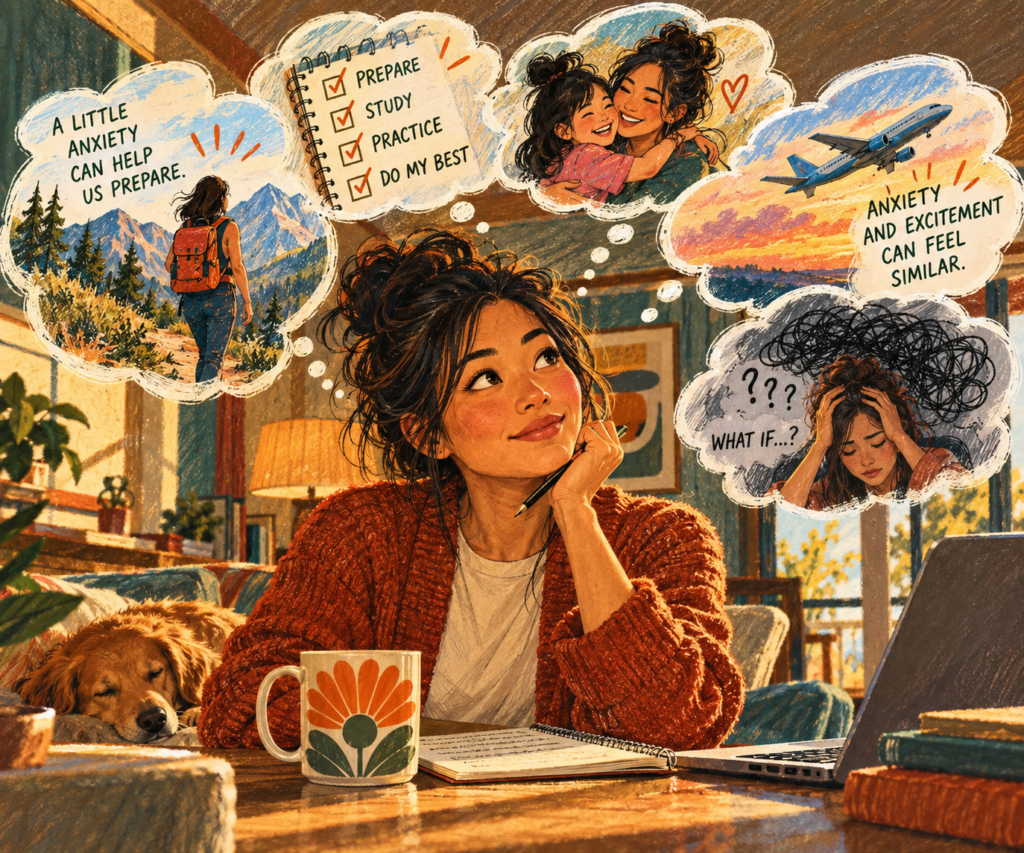
The Achoo! Excuse My Anxiety Series
Anxiety can be good.
Anxiety can be bad.
And anxiety is most certainly part of life.
Sometimes we recognize it immediately. Other times, we give it another name. Stress. Worry. Frustration. Irritability. Feeling overwhelmed. Having too much on our plate.
Or perhaps we don’t give it a name at all.
We simply go about our day without realizing how much anxiety may be influencing the way we think, feel, behave, and interact with the people around us.
Anxiety has a funny way of finding its way into just about every corner of our lives.
And that isn’t necessarily a bad thing.
Wait. Anxiety Can Be Good?
Absolutely.
Think about it.
A little anxiety before a job interview might encourage us to prepare. Anxiety about an upcoming exam might motivate us to study instead of spending another three hours watching Netflix. Feeling anxious when our child runs toward a busy street might help us react quickly.
Anxiety can help us recognize danger, prepare for uncertainty, pay attention to something important, and sometimes even accomplish things we might otherwise put off until tomorrow.
Or next Tuesday.
Or whenever we finally feel like doing them.
Anxiety can also show up in our relationships in ways that aren’t necessarily unhealthy.
Perhaps we’re nervous about apologizing to someone we love. Maybe we’re anxious about having a difficult conversation with our romantic partner, asking someone on a date, or telling someone how much they mean to us.
That anxiety doesn’t automatically mean something is wrong.
Sometimes it means something matters.
And here’s another interesting possibility.
Anxiety and excitement can feel remarkably similar in our bodies.
Our hearts race. Our stomachs flutter. Our breathing changes. We may feel restless, energized, or unusually alert.
Think about riding a roller coaster, preparing for a first date, or waiting to hear whether we got that job we really wanted.
Sometimes what we call anxiety is part of the anticipation of something wonderful.
Of course, that doesn’t mean every anxious feeling is secretly excitement. Sometimes anxiety is painful, exhausting, or genuinely overwhelming.
But perhaps we can begin by recognizing that anxiety isn’t always the enemy.
Sometimes we need to listen to it.
Sometimes we need to regulate it.
And sometimes we simply need to make a little room for it while we do something meaningful anyway.
When Anxiety Starts Driving
There is a difference between anxiety helping us navigate life and anxiety beginning to navigate life for us.
Imagine you’re driving down the road.
A little anxiety might encourage you to pay attention to traffic, notice the car braking in front of you, or slow down when the weather gets bad.
Wonderful.
That’s anxiety doing something useful.
But imagine becoming so anxious about driving that you spend the entire trip gripping the steering wheel, imagining every possible accident, questioning every decision, and struggling to enjoy the ride.
Same road.
Same car.
Very different experience.
Anxiety may have started as something trying to protect you.
But somewhere along the way, it began taking over the trip.
And that can happen in relationships too.
We might become so anxious about disappointing someone that we stop expressing our own needs. So worried about conflict that we avoid important conversations. So concerned about what others think that we begin organizing our lives around keeping everyone happy.
Sometimes we even become anxious about feeling anxious.
Now anxiety has given itself another job.
That’s a lot of responsibility for one emotion.
Building Our Anxiety Muscles
This is where anxiety tolerance becomes important.
Think of anxiety tolerance as a muscle.
Like other muscles, it can become stronger with practice. We can gradually develop a greater ability to experience anxiety without immediately needing to escape it, eliminate it, or do something about it.
And perhaps the best part is that we don’t necessarily need a gym membership.
We already have a gym.
It’s called life.
More specifically, some of our best opportunities to exercise this muscle may be waiting for us at home.
With our romantic partners. Our children. Our parents. Our siblings. Our extended families.
And yes, even our canine and feline family members, although I’m not entirely convinced cats are particularly interested in helping us become emotionally regulated.
Think about how many opportunities we have to practice tolerating a little discomfort in everyday life.
Someone disagrees with us.
Plans change.
Our child doesn’t listen.
Our romantic partner has a different opinion.
Someone forgets something important.
We don’t receive the response we were hoping for.
None of those experiences automatically requires an emergency response.
But depending on what we’ve learned, what we’re carrying, and how we’re feeling that day, our bodies and minds may respond as though something much bigger is happening.
That’s where the practice begins.
Not necessarily by making the discomfort disappear, but by recognizing that we can experience it and still choose how we want to respond.
Why Home Can Be Our Hardest Gym
For many of us, home is where anxiety becomes especially noticeable.
We may spend the day navigating work, school, traffic, deadlines, bills, errands, and everything else life throws our way.
Then we come home.
Sometimes carrying a little more anxiety than we realize.
And who gets to experience it?
Often, the people we love the most.
That’s an interesting contradiction.
The people we most want to love, protect, enjoy, and feel close to may also be the people around whom we become the most anxious, frustrated, impatient, or emotionally reactive.
Sometimes we hurt the people we love.
Sometimes they hurt us.
Sometimes nobody intends to hurt anybody, but somehow everybody ends up having a difficult evening.
And sometimes all of this happens because someone forgot to unload the dishwasher.
Relationships are funny that way.
Of course, not every home is emotionally safe, and not every relationship is a healthy place to practice tolerating discomfort. Anxiety can also alert us to real danger, mistreatment, or situations that genuinely need to change.
But in relationships where we have enough safety and mutual respect, everyday interactions can offer tremendous opportunities to grow.
Just like going to the gym, some days we feel strong and ready to put in the work.
Other days, we would rather stay on the couch.
Building anxiety tolerance can feel much the same.
It takes practice.
And sometimes the smallest repetitions matter the most.
We Don’t Have to Get Rid of It
I think there’s something important about the language we use when talking about anxiety.
We often speak about it as though the goal is to get rid of it.
Stop worrying.
Calm down.
Don’t be anxious.
Relax.
As though anxiety were something we could simply switch off whenever it became inconvenient.
But perhaps a more useful question is not, “How do I get rid of this feeling?”
Perhaps it’s, “Can I learn to experience this feeling without allowing it to make every decision for me?”
Can I feel nervous and still have the conversation?
Can I feel uncertain and still move forward?
Can I be disappointed without immediately becoming defensive?
Can I love someone without needing to control their thoughts, feelings, or choices?
Can I be anxious and still be the person I want to be?
Those are different questions.
And they may lead us somewhere more useful.
Because the goal isn’t necessarily to become a person who never experiences anxiety.
That would be a pretty unusual human.
Perhaps the goal is to become someone who recognizes anxiety, understands a little more about what it may be trying to accomplish, and gradually develops more freedom in how to respond.
And that brings us to another important question.
What does anxiety actually look like for you?
Not what it’s supposed to look like.
Not what it looks like for your romantic partner, your parents, your children, or your neighbor who somehow seems completely relaxed about absolutely everything.
What does it look like for you?
That’s where we’re going next.
Because before we can become better at tolerating anxiety, we probably need to become a little better at recognizing it.